
Forsyth City Directory Collections
Forsyth historical directories survive in several forms, so the strongest search does not depend on one website. The North Carolina Room reports a physical shelf running from 1898 to the present, although a reported shelf range is not proof that every year is on hand. Older published volumes also survive through DigitalNC and linked Internet Archive copies. Their titles can cover Winston, Salem, Winston-Salem, or a wider Winston-Salem and Forsyth area. Record the title exactly before deciding that a family is absent. A surname may be filed under a city label that a modern searcher would not expect.
| Collection | Years represented | Where held | Access route |
|---|---|---|---|
| North Carolina Room directory volumes | 1898 to present reported | Forsyth County Public Library | Call ahead and verify the needed year |
| Emerson and Inter-State volumes | 1879 to 1880; 1884 | DigitalNC and Internet Archive | Free item records and scans |
| Turner & Co. directories | 1889 to 1895 | DigitalNC, with FCPL contribution | Free metadata and digital reading |
| Walsh Directory Co. volumes | 1902 to 1908 and later titles | DigitalNC, FCPL, and UNC | Browse the volume by year |
| Piedmont and Miller volumes | 1920, 1925, and other years | DigitalNC, FCPL, and UNC | Item-specific access |
| Hill Directory Co. volumes | Selected years from 1934 to 1958 | DigitalNC and FCPL | Confirm the volume and section |
Gaps matter. The documented digital sequence is selected rather than continuous, and no source supports claiming a complete reverse-directory run. Ask the library for the exact volume, its alphabetical pages, its street-and-avenue guide, and any related telephone books or yearbooks. That request is more useful than assuming a missing web result means the printed volume never existed.
Forsyth Historical Directory NC Room
The North Carolina Room is the practical local fallback for a Forsyth historical directory volume that is not digitized or is difficult to read online. Its library resources include local newspapers, ArchiveGrid, North Carolina materials, and branch-only Ancestry Library Edition. Call 336-703-3070 and ask for the North Carolina Room, then name the year, the street, and the surname. Staff can help locate directories, newspaper microfilm, obituary material, telephone books, yearbooks, photographs, maps, and vertical files. Appointments are advised for genealogy help.
The North Carolina Room collection contact page documents the local-history and archive setting behind that request.
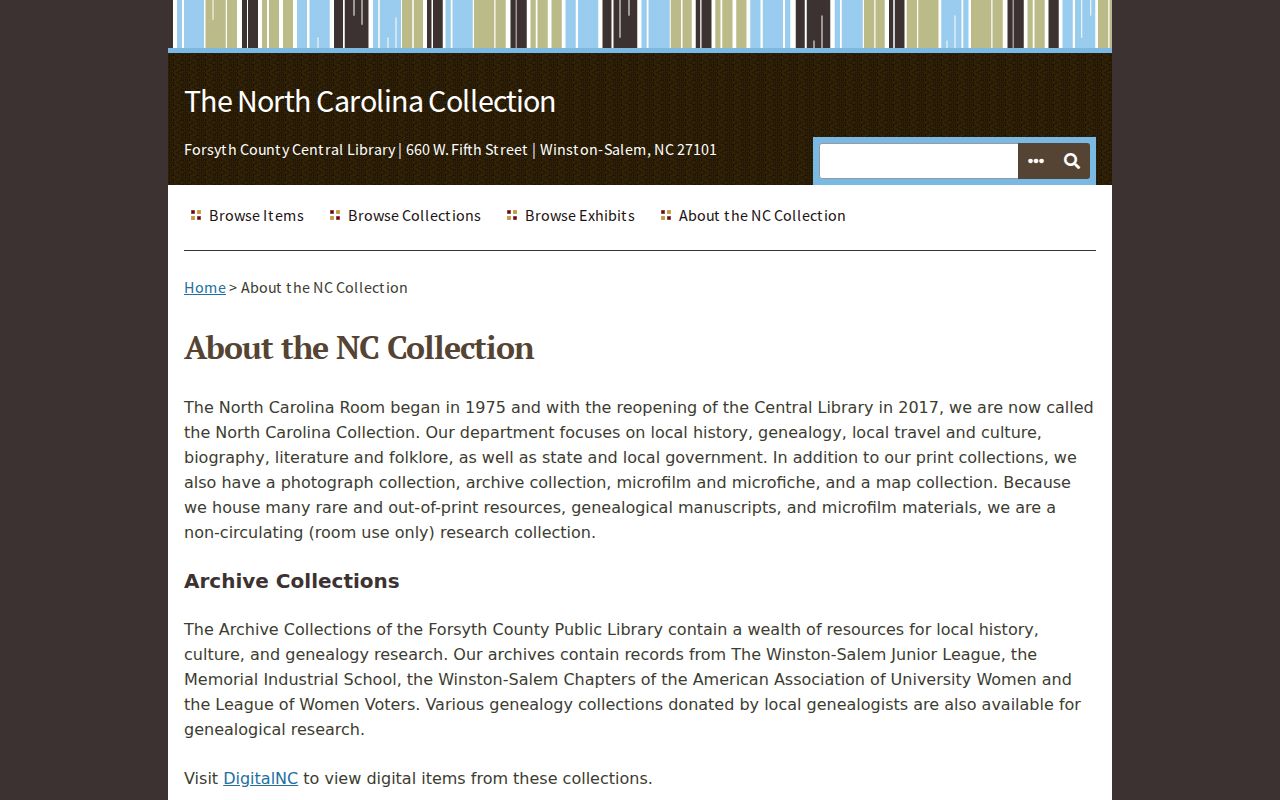
Its archival, map, microfilm, and genealogy holdings make the room a useful bridge between a directory line and the records that explain it.
Branch-only database access is another important channel. A census or vital index result can supply a spelling, spouse, or age that helps distinguish two similar directory entries. Keep the source type clear: a directory is a published association with an address at publication time, while a census is a household snapshot and a deed is an ownership document.
Note: Confirm shelf availability before visiting because the reported 1898-to-present range does not guarantee every directory year is present.
Digital Forsyth Directory Volumes
DigitalNC is the main free route for older Forsyth directories. Each item can supply the title, date text, publisher or creator, geographic coverage, repository, local call number, and, when available, a linked Internet Archive PDF. That metadata is useful evidence on its own. It tells a researcher whether a scan belongs to Winston, Salem, a combined city, or a broader gazetteer before the pages are searched. Start with the closest year and inspect neighboring years when a person moves or a street number changes.
The 1902 to 1903 Walsh directory record at DigitalNC is one example of the item-level publisher and repository information available before opening a scan.
Use the item record to preserve the directory year and repository alongside any transcription from its pages.
Digital copies complement, rather than replace, the library shelf. The contributing institution may be Forsyth County Public Library or UNC-Chapel Hill's Wilson Special Collections Library, and the Internet Archive copy may be a linked surrogate. The physical North Carolina Room remains the fallback for the locally reported run, microfilm, and staff help when the needed item is not online.
Reading Forsyth Directory Entries
A published Forsyth directory entry must be read with the key for its own year. The inspected 1939 introduction describes an alphabetical section for names, residents, and businesses, plus a directory of householders with a street-and-avenue guide. A resident line can carry a surname and given name, marital or spouse notation, occupation, address, and sometimes a business relationship. The presence and meaning of abbreviations or status marks vary by volume. Read the front matter before copying a mark into a family file.
| Name line | Surname, given name, initials, and sometimes spouse or marital notation |
|---|---|
| Address | A residence or business address as printed for that directory year |
| Occupation | A period identity cross-check that can help separate similar names |
| Street guide | Street, numbered address, householder or business, and crossing streets |
| Front-matter marks | Year-specific abbreviations and symbols whose meaning must be checked in that volume |
- Criss-cross directory
- A directory arranged by address or street so a researcher can move from a numbered location to the printed householder or business.
- Householder index
- The part of a volume that emphasizes the person responsible for a listed address, not a complete list of everyone there.
- Abbreviation key
- The explanation pages, usually near the front, that define the shortened terms used in that particular edition.
The street guide is valuable for house history because it can show crossing streets and the order of numbers along a block. It is still a published historical source, not a complete roster. Do not turn one entry into a claim about every person at an address or about anyone's current location.
The 1939 Hill Directory
The 1939 Hill volume gives Forsyth researchers a clear example of how much one book can contain. Its documented structure has five major departments: an alphabetical list, a householder and street guide, a buyers' guide, a classified business section, and civic or institutional material. The general index also points readers toward subjects such as churches, schools, cemeteries, libraries, hospitals, associations, government, and the street guide. That structure rewards a deliberate search. A name hit may be only the opening lead to a street, institution, or newspaper follow-up.
The 1936 Hill directory item at DigitalNC shows the type of repository and publisher metadata available for the later Hill era.
Preserving the title, edition, and repository with a result prevents one Hill-era volume from being mistaken for another.
One documented 1939 notation concerned a period-specific home-status designation. It should be treated as an artifact of that edition, not as a modern ownership field or a rule for earlier Turner and Walsh volumes. The book's own key controls the meaning.
Winston, Salem, and Directories
Historic place names are a core Forsyth city-directory problem. Salem's Moravian record tradition, Winston's role as county seat, and the combined Winston-Salem label all appear in local material. Winston and Salem merged in May 1913, but the same person or street can be indexed under an older city name without any physical move. Search Winston, Salem, and Winston-Salem in the title, address line, and street guide before treating an absence as final.
The City of Winston-Salem history source supplies the municipal chronology behind that naming change. Compare the publication title, street spelling, crossing streets, ward or neighborhood, and family names. Those fields are more reliable than forcing every result into a modern place label.
Historic neighborhoods can add another search path. Old Salem, West End, Happy Hill, Bethabara, and several documented African-American neighborhoods may appear in maps, newspapers, school materials, or community files even where an address is missing from a directory. A neighborhood is a locator for research, not proof of a household.
Forsyth Directory Publishers
Publisher changes help set expectations for layout, abbreviations, and title geography. The verified sequence starts with multi-town Emerson material in 1879 to 1880, followed by an 1884 Inter-State directory and gazetteer. Turner & Co. appears from 1889 through 1895, Walsh Directory Co. from 1902 through 1908, Piedmont or Ernest H. Miller in the 1920s, and Hill in the 1930s through 1950s. The library's reported shelf then reaches beyond those selected online examples.
| 1879 to 1884 | Multi-town Emerson and Inter-State titles preserve Winston, Salem, and wider regional geography. |
|---|---|
| 1889 to 1895 | Turner & Co. volumes mark an early sustained local directory sequence. |
| 1902 to 1908 | Walsh titles provide a different publisher and changing Winston-Salem naming. |
| 1920s | Piedmont and Miller volumes are documented for selected years. |
| 1930s to 1950s | Selected Hill and Miller volumes continue the historical run. |
Use this chronology as a finding aid, not as a promise of uninterrupted publication. Confirm a particular year at the NC Room or DigitalNC, and preserve the exact edition in research notes.
Trace Forsyth Directory Households
Tracing a household through Forsyth directories works best as a sequence of dated checks. Begin with the alphabetical section, then test the same address in the street guide. Repeat in adjacent years, including variant initials, a spouse's surname, a boarding-house address, and alternate Winston or Salem labels. Pair the annual or near-annual directory evidence with the federal census, which is a decennial household snapshot. The 1950 census is the latest released under the 72-year rule described in current State Library guidance.
- Find the surname and given name, then record the exact address, occupation, spouse notation, and any abbreviation.
- Check the street-and-avenue guide for the number, street spelling, crossing streets, and printed householder or business.
- Repeat the check in nearby directory years, noting a move, a new spelling, or a changed city label.
- Compare the closest available 1900 through 1950 census household for age, relationships, birthplace, occupation, and street or community.
- Use a deed, tax map, obituary, probate record, cemetery record, or Sanborn map to resolve remaining same-name conflicts.
A disappearance has several possible explanations. The person may have moved, died, changed a surname, been listed under a business heading or boarding house, or simply not been included by that edition. The Forsyth previous residents trail uses the same directories alongside deeds and map evidence when the question centers on one address over time.
Forsyth Directory Endpoints
When a directory trail ends, use a source that answers the reason for the change rather than guessing. The Forsyth County Public Library's searchable local-newspaper index covers the Winston-Salem Journal, The Sentinel, Union Republican, Winston-Salem Chronicle, and Clemmons Journal. Search a surname with an address or street, then ask the North Carolina Room about date coverage, microfilm, and obituary material because the public resource did not expose exact index runs. City-owned Woodland and New Evergreen cemeteries keep historical interment records, but their office is the route because no public name-search form was located.
Older estate, court, land, tax, vital, and miscellaneous county material may instead lead to the North Carolina State Archives county-record collections. The Archives catalog and copy-request channel are useful when a visit is not possible. An obituary, cemetery record, or probate file can explain a household change, but it should be compared with the official custodian record before it is treated as conclusive.
Note: A directory line establishes a published address association for its edition, not a complete household list or a present-day locator.